

Estimated read time: 8 min 45 sec
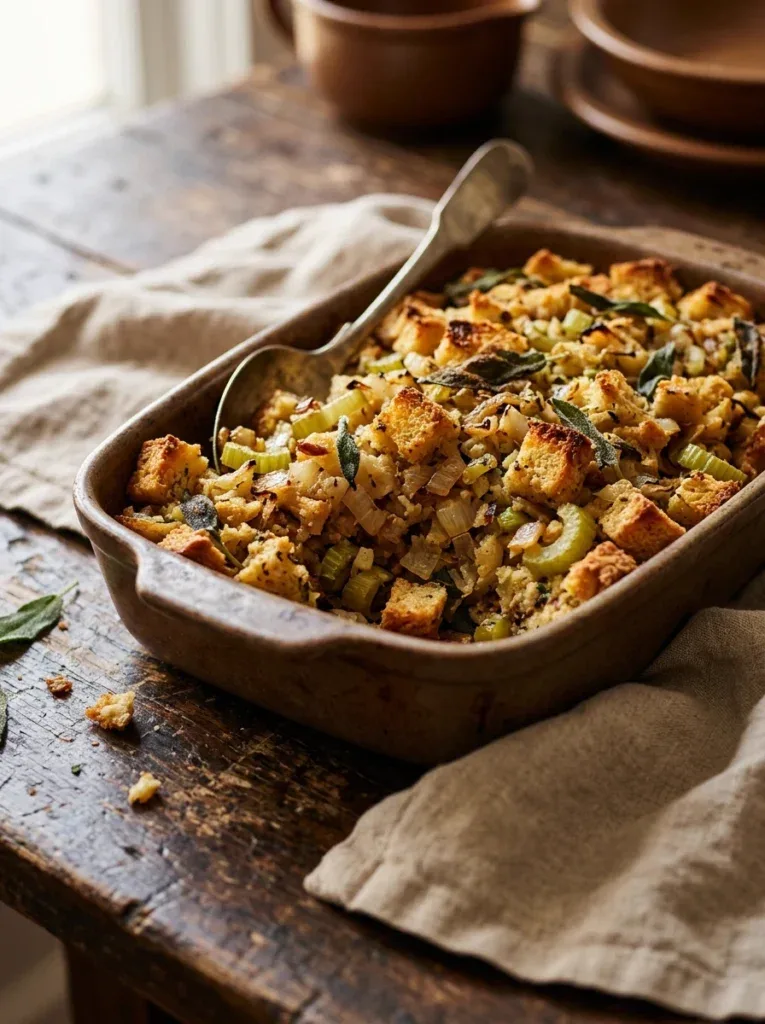
Every family has strong feelings about holiday stuffing, and in my kitchen, the ideal pan of classic sage and onion stuffing (baked outside the bird in a 9-by-13-inch casserole dish) has two distinct textures in every scoop: a golden, craggy top crust of toasted bread corners and a tender, savory bread-pudding center underneath. Achieving both without ending up with either dry croutons or a soggy block comes down to three steps: oven-drying your ¾-inch cubes of rustic white bread first so they can drink in flavorful stock without collapsing, sweating the diced onion and celery in plenty of butter before blooming the fresh sage, and pouring the egg-and-broth mixture over the bread in stages while testing a cube from the bottom of the bowl.
Servings: 8 servings · Prep: 20 minutes · Cook: 55 minutes · Total: 75 minutes
Cuisine: American
How I Choose the Bread & Gauge the Broth
Not every 1-pound (450 g) loaf of bread absorbs the exact same volume of broth. A tight-crumbed country white loaf or bakery French boule holds its cube shape and drinks up the full 2 cups (480 ml) of stock, whereas a soft supermarket sandwich loaf absorbs liquid faster and can turn pasty if over-soaked. That is why I always oven-dry the ¾-inch cubes at 300°F for 15 minutes until the outsides feel crisp like croutons, and keep an extra ½ cup of warm low-sodium broth next to the mixing bowl so I can tailor the final splash to the specific loaf I bought.
Key Ingredients & Why They Matter
- Rustic White or Country Sourdough Bread (450 g / 1 lb, Cut into ¾-Inch Cubes): Cutting the loaf into generous ¾-inch cubes gives each piece enough structure to stay distinct after tossing with warm aromatics and broth. Leave the crusts on—they add chew and toast golden around the edges of the casserole.
- Unsalted Butter (85 g / 6 tbsp) + Yellow Onion & Celery: Sweating the onion and celery gently in 6 tablespoons of butter for 8 to 10 minutes until translucent and pliable ensures you never bite into raw, crunchy celery in the baked stuffing, while the herb-infused butter coats the bread cubes from within.
- Fresh Sage & Fresh Flat-Leaf Parsley (2 tbsp each) + 2 Large Eggs: Whisking 2 eggs into the low-sodium broth binds the moistened bread cubes into a light, custodial interior that puffs gently under the foil cover before browning uncovered for the final 15 minutes.
Ingredients
- 450 g (1 lb) rustic white bread, cut into ¾-inch cubes
- 85 g (6 tbsp) unsalted butter, plus more for the dish
- 1 large yellow onion, diced
- 3 celery ribs, diced
- 2 tbsp chopped fresh sage
- 2 tbsp chopped fresh parsley
- 480 ml (2 cups) low-sodium broth, plus a splash if needed
- 2 large eggs
- ½ tsp fine salt
- ½ tsp black pepper
Instructions
Step 1. Dry the bread cubes and raise the oven temperature
Heat the oven to 300°F (150°C). Cut the bread into uniform ¾-inch cubes and spread them in a single layer across a large rimmed baking sheet (or two sheets if crowded). Bake for 15 minutes, tossing once halfway through, until the exteriors feel dry and crisp without browning. Transfer the dried cubes to an extra-large mixing bowl, raise the oven temperature to 350°F (175°C), and butter a 9-by-13-inch baking dish.
Step 2. Soften the onion and celery while the bread dries
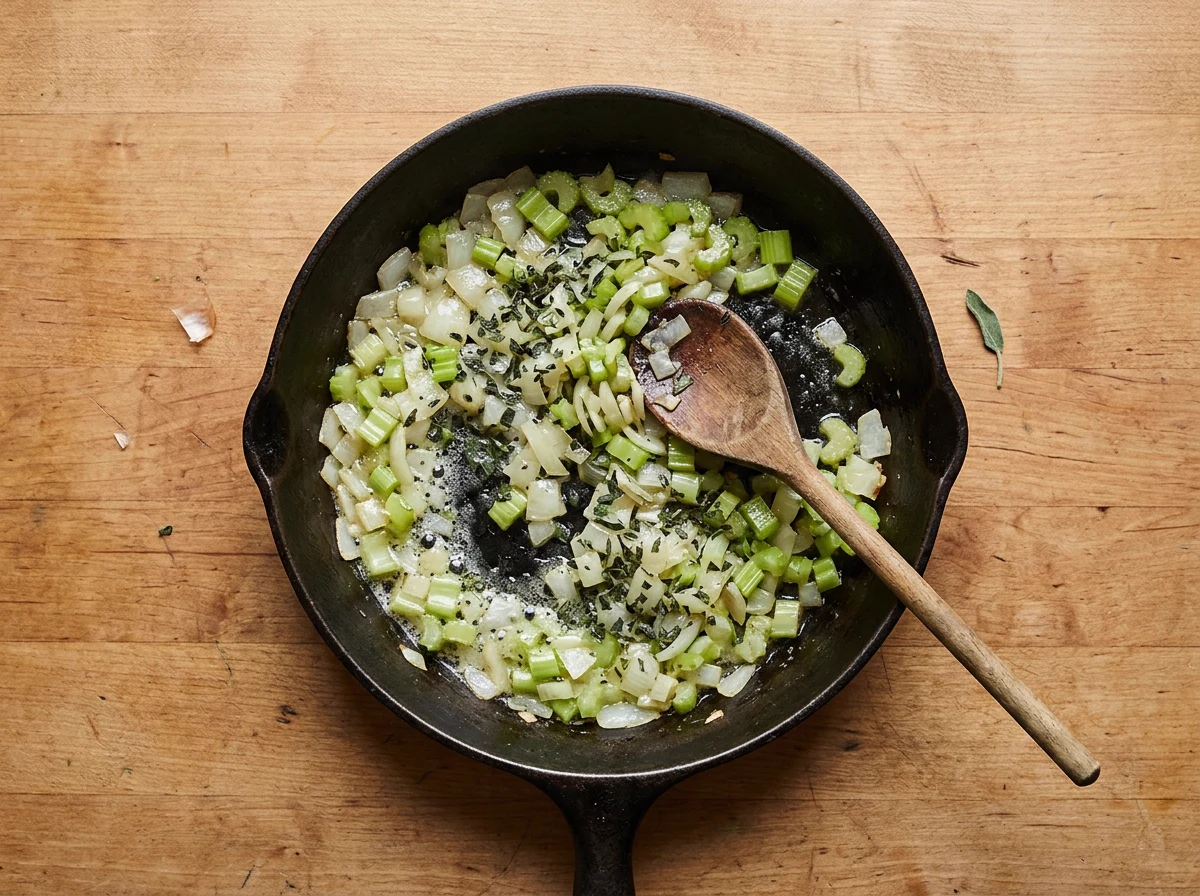
While the bread cubes dry in the oven, melt the 85 g (6 tablespoons) unsalted butter in a wide skillet over medium heat. Add the diced yellow onion and diced celery and cook for 8 to 10 minutes, stirring occasionally, until the onion turns translucent and the celery bends easily without browning.
Step 3. Bloom the fresh herbs and toss with the bread
Add the chopped fresh sage, chopped parsley, ½ teaspoon fine salt, and ½ teaspoon black pepper directly to the hot butter and vegetables in the skillet. Stir for 30 to 45 seconds just until the warm butter releases the unmistakable piney aroma of the sage. Scrape the entire skillet—including every drop of herb butter—over the bowl of dried bread cubes and toss gently from the bottom up.
Step 4. Whisk the broth and eggs
In a large measuring pitcher or bowl, whisk the 2 large eggs and 2 cups (480 ml) low-sodium turkey, chicken, or vegetable broth together until completely uniform with no streaks of egg white.
Step 5. Moisten the cubes in stages and test a center
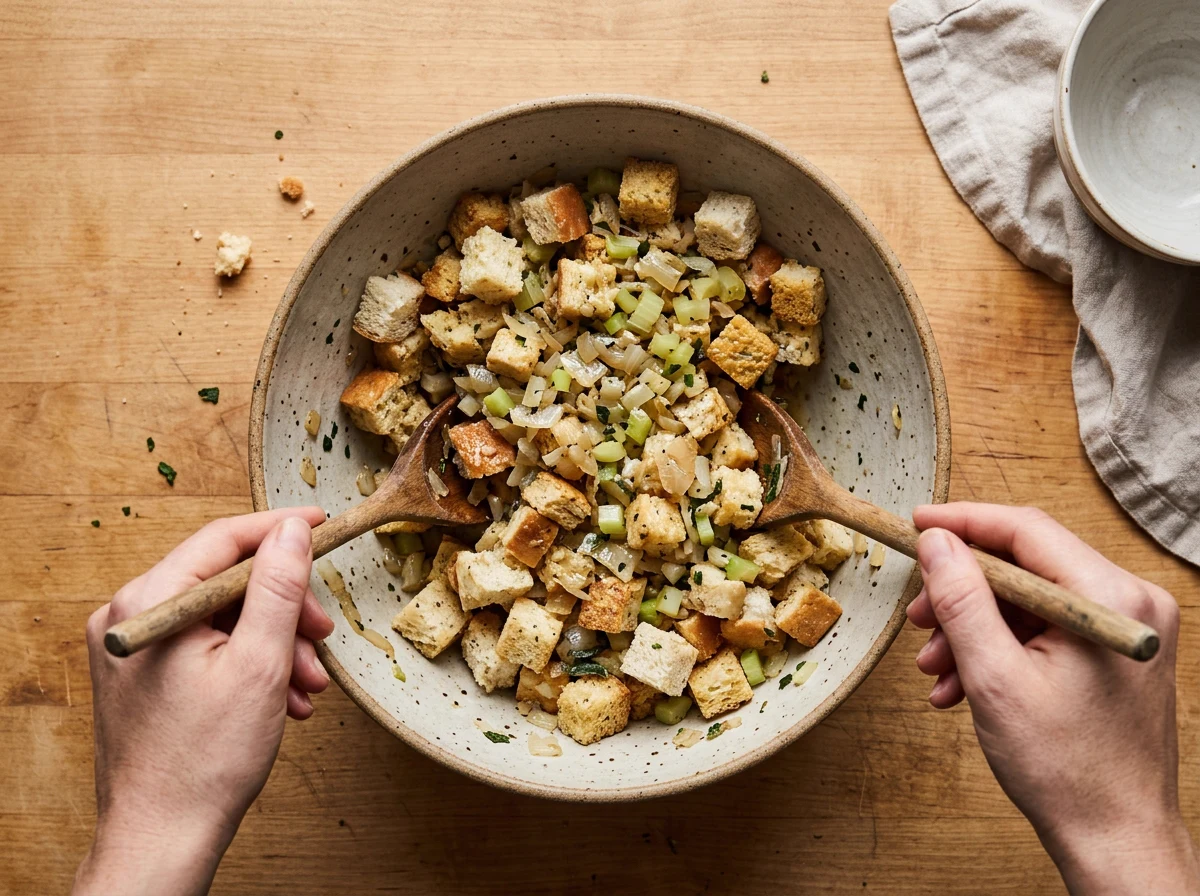
Pour half of the egg-and-broth mixture over the bread cubes, fold gently with a wide spatula, and let it sit for 2 minutes so the dry crumb drinks in the liquid. Pour in the remaining mixture and fold again. To check the hydration, pick up one of the thickest cubes and split it in half with a spoon: it should look moistened all the way to the core without liquid pooling at the bottom of the bowl. If a dense sourdough or country loaf still shows a chalky dry core, drizzle in an extra 2 to 4 tablespoons of plain broth.
Step 6. Spread loosely in the dish and bake covered
Tumble the moistened bread mixture into your buttered 9-by-13-inch baking dish and nudge it into an even layer—never pack or press it flat with the back of a spoon, which squeezes out the air pockets and prevents the top peaks from crisping. Cover the dish tightly with aluminum foil and bake at 350°F (175°C) for 25 minutes so trapped steam sets the egg custard gently in the center.
Step 7. Uncover to crisp the top and verify 165°F
Remove the foil and bake uncovered for another 15 to 20 minutes until the exposed bread tips turn deep golden brown and crisp and an instant-read thermometer inserted into the center of the casserole reaches at least 165°F (74°C) per FoodSafety.gov’s temperature chart.
Step 8. Rest briefly and scoop with crisp edges
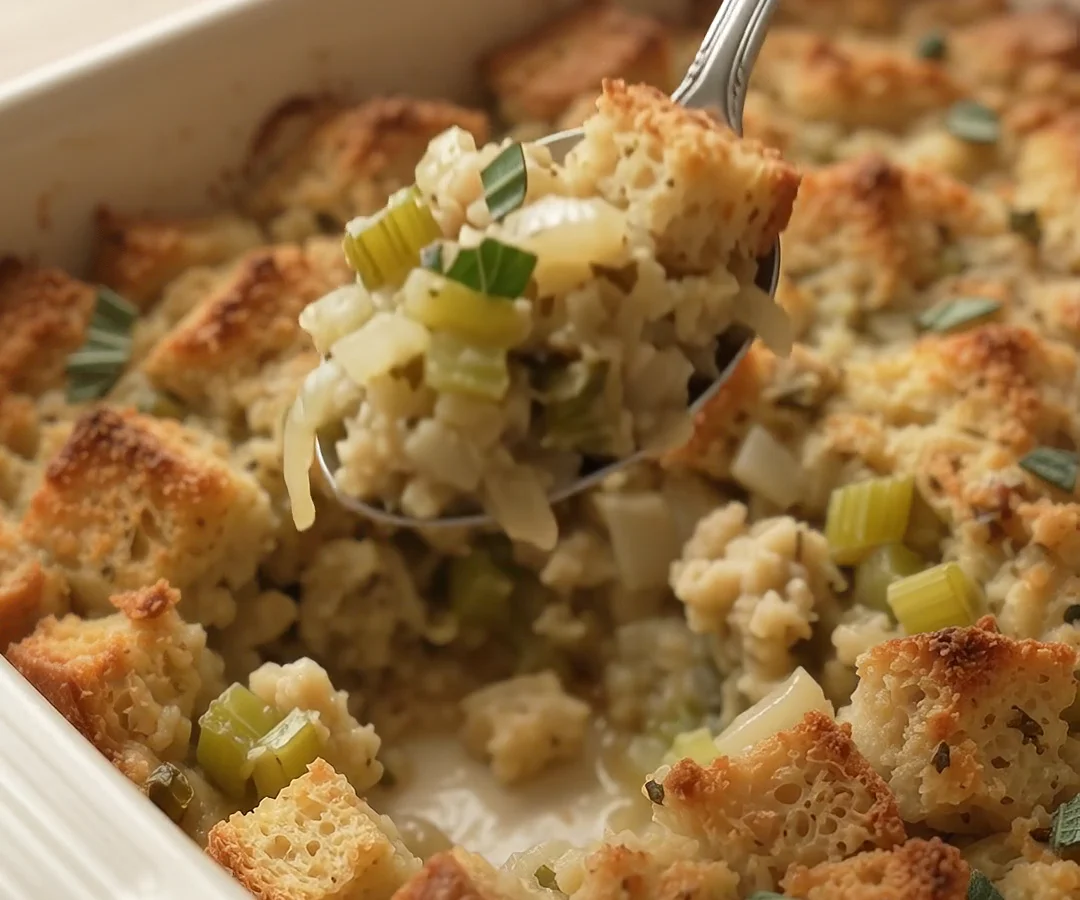
Let the dish rest on a cooling rack for 5 minutes so the steam settles and the slices hold together when scooped. Use a wide serving spoon to give every guest both the crunchy toasted top crust and the soft, herb-scented center underneath.
My Make-Ahead Strategy for a Busy Holiday Oven
Because raw egg-soaked bread can compact if left assembled in the fridge overnight, here is how I split the work on our Make-Ahead Thanksgiving Menu:
- Component Prep (Recommended): Cube and oven-dry the bread a day ahead, let it cool completely, and store it covered at room temperature. Sauté the butter, onion, celery, sage, and parsley the day before, cool, and refrigerate in a covered container. On Thanksgiving afternoon, simply toss the dried bread, aromatics, and whisked egg-broth together right before sliding the dish into the 350°F oven alongside your Garlic Herb Roast Turkey Breast.
- Full Bake-Ahead Option: If your single oven doesn’t have room for two pans at once, bake the stuffing completely the day before, cool it promptly in shallow containers within 2 hours, and refrigerate. Reheat covered at 350°F (or 375°F while the turkey rests) with a 2-tablespoon drizzle of broth until the center reaches 165°F, uncovering for the final 5 minutes to re-crisp the top.
Frequently asked questions
Can I use sourdough bread instead of country white bread?
Yes! A mild country sourdough loaf makes wonderful stuffing because its sturdy crumb holds ¾-inch cubes without disintegrating. Because artisan sourdough crusts can be chewy, cut thick outer crust pieces slightly smaller (around ½ inch) so they soften at the same pace as the interior crumb.
How can I make this stuffing 100% vegetarian?
Simply use a flavorful low-sodium vegetable stock (ideally one simmered with mushrooms, onion, and thyme) in place of turkey or chicken broth—everything else in the recipe is already vegetarian.
Why do we bake covered with foil first and uncovered second?
Because the recipe contains 2 eggs and dried bread cubes, the first 25 minutes under foil traps steam so the bread hydrates evenly and the egg binder sets to a safe 165°F in the center without scorching the top cubes.
Estimated nutrition
About 255 kcal, 7.2 g protein, 30.3 g carbohydrates and 11.7 g fat per serving. Estimate uses one eighth of the casserole with generic rustic white bread, low-sodium broth and all 85 g butter. Excludes extra butter for the dish.
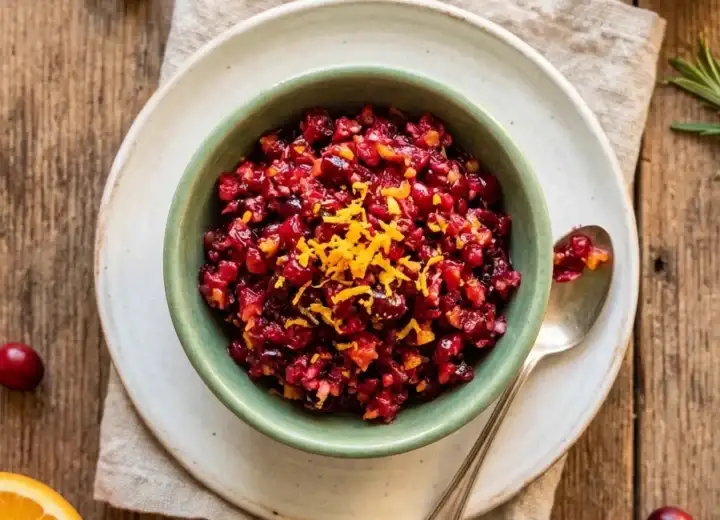
Serve warm spoonfuls next to carved Garlic Herb Roast Turkey Breast with a ladle of Turkey Gravy Without Drippings and a bright spoonful of Cranberry Orange Sauce.
Reader comments