

Estimated read time: 8 min
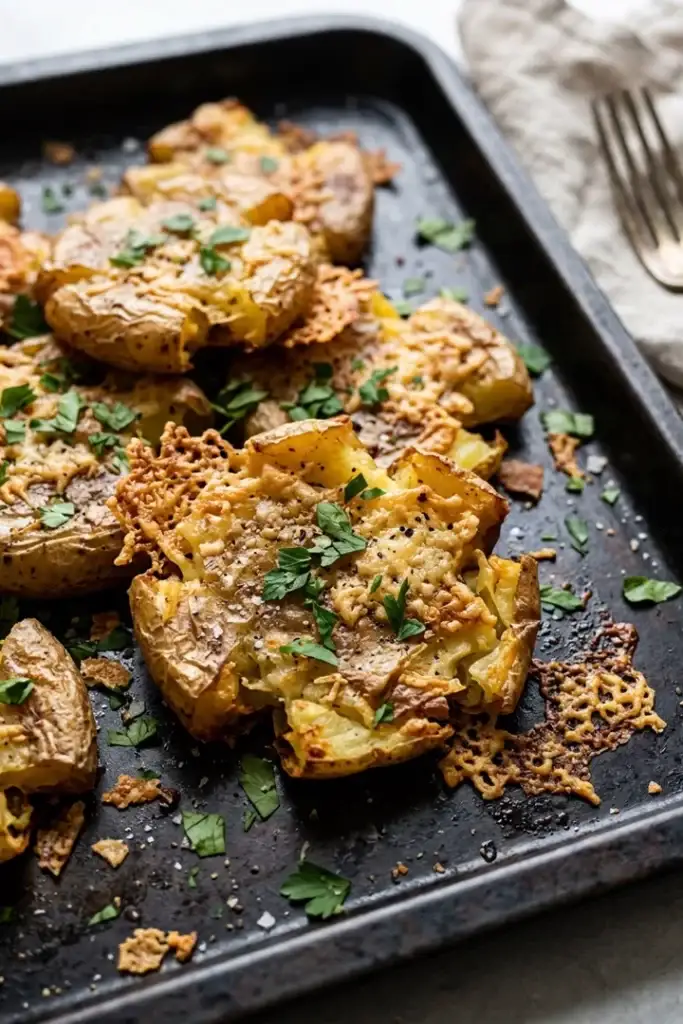
When I make crispy Parmesan smashed potatoes, I always let the drained potatoes steam-dry in the colander until their skins look completely matte before pressing them flat. Simmering them until a paring knife slides in without resistance ensures they crack open cleanly under a flat-bottomed glass, giving you a fluffy center and ragged edges that roast into a lacy collar of crunchy cheese.
Servings: 4 side servings · Prep: 15 minutes · Cook: 50 minutes · Total: 72 minutes
Cuisine: International
Choose baby potatoes that flatten evenly
Pick small Yukon Golds of similar size. Have a flat-bottomed cup ready for smashing and clear enough tray space for the edges that spread out. Grate the Parmesan before the potatoes go into the oven so you can add it evenly at the stage specified below.
Key Ingredients & Why They Matter
- Baby Yukon Gold potatoes (700 g): Yukon Golds have an ideal medium-starch balance that boils to a creamy, cohesive interior while their thin skins split into jagged ridges that crisp rapidly without shattering into dry crumbs.
- Olive oil (2 tbsp): Dividing the oil evenly—one tablespoon brushed across the metal sheet pan and one brushed over the smashed tops—maximizes heat conduction from the tray to fry both the bases and the torn potato edges.
- Finely grated Parmesan (35 g): Because aged Parmesan is low in moisture and rich in glutamate-packed proteins, grating it finely lets it melt and fuse with the potato starch into a lacy, frico-like crust at 425°F.
- Fine sea salt (½ tsp, plus more for boiling water): Salting the simmering water seasons the dense potato flesh from within as starch granules hydrate, while the measured ½ teaspoon on top sharpens the nutty cheese crust.
Ingredients
- 700 g baby Yukon Gold potatoes
- 2 tbsp olive oil
- ½ tsp fine sea salt, plus more for the boiling water
- ¼ tsp black pepper
- 35 g finely grated Parmesan
- 1 tbsp chopped parsley
Choose baby Yukon Gold potatoes around 4 cm across if you can. Spread them out on a heavy rimmed metal baking sheet, or use two if one tray won’t hold them with room around each. Divide the two tablespoons of olive oil between the tray and the tops. The total includes five minutes of steam-drying and a two-minute rest after roasting.
Instructions
Step 1. Choose potatoes that are close in size
Scrub the potatoes and leave their skins on. Pick out especially large ones and cook them separately if they are much larger than the rest. Similar sizes make it easier to lift the whole batch out at once when the centers soften.
Step 2. Start in cold salted water and check the largest potato
Cover the potatoes with cold salted water, then bring it to a boil and reduce it to a steady simmer. Heat the oven to 425°F (220°C) while the potatoes cook. Start checking after about 15 minutes of simmering and allow up to 20. A paring knife should slide into the largest potato with almost no resistance.
Step 3. Drain and steam-dry before pressing
Drain in a colander and leave the potatoes uncovered for about five minutes. While the steam escapes, brush one tablespoon of the oil over the tray. A potato is ready to press when the skin looks matte and leaves no wet patch on the pan. Give visibly damp potatoes another minute or two.
Step 4. Press each potato to about 1 cm thick
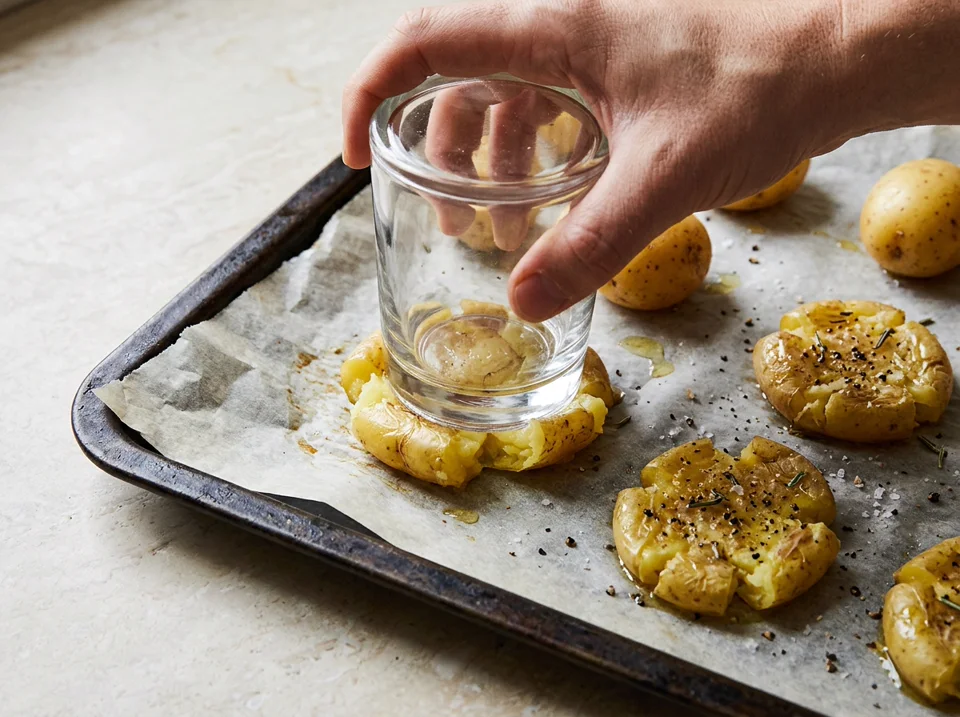
Set the dry potatoes apart on the oiled tray. Press each one slowly with a flat-bottomed glass until the edge spreads and cracks. Aim for roughly 1 cm thickness. Gather any separated chunks next to the potato so they can roast together, and keep tiny fragments away from the hottest outer edge.
Step 5. Brush oil over the tops and ragged edges
Use the remaining tablespoon of oil to coat the tops. Run the brush across the torn edges where they meet the tray. Sprinkle over the measured salt and pepper. If you can see pools of oil around one potato, sweep some of it onto a pale patch on another.
Step 6. Scatter a thin layer of Parmesan
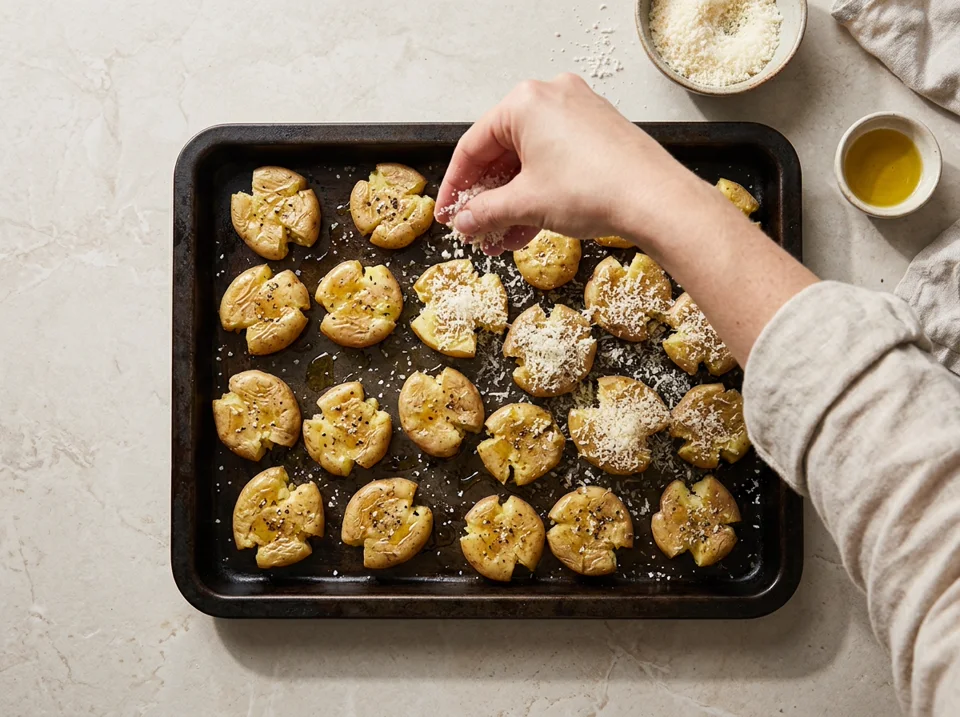
Grate the Parmesan finely and divide it among the potatoes. Sprinkle some just beyond their outlines to make a thin crisp edge. Spread out any clump in the middle so the cheese can brown evenly. Keep the loose cheese close to each potato so it’s easier to lift with a spatula later.
Step 7. Roast and check the bottoms
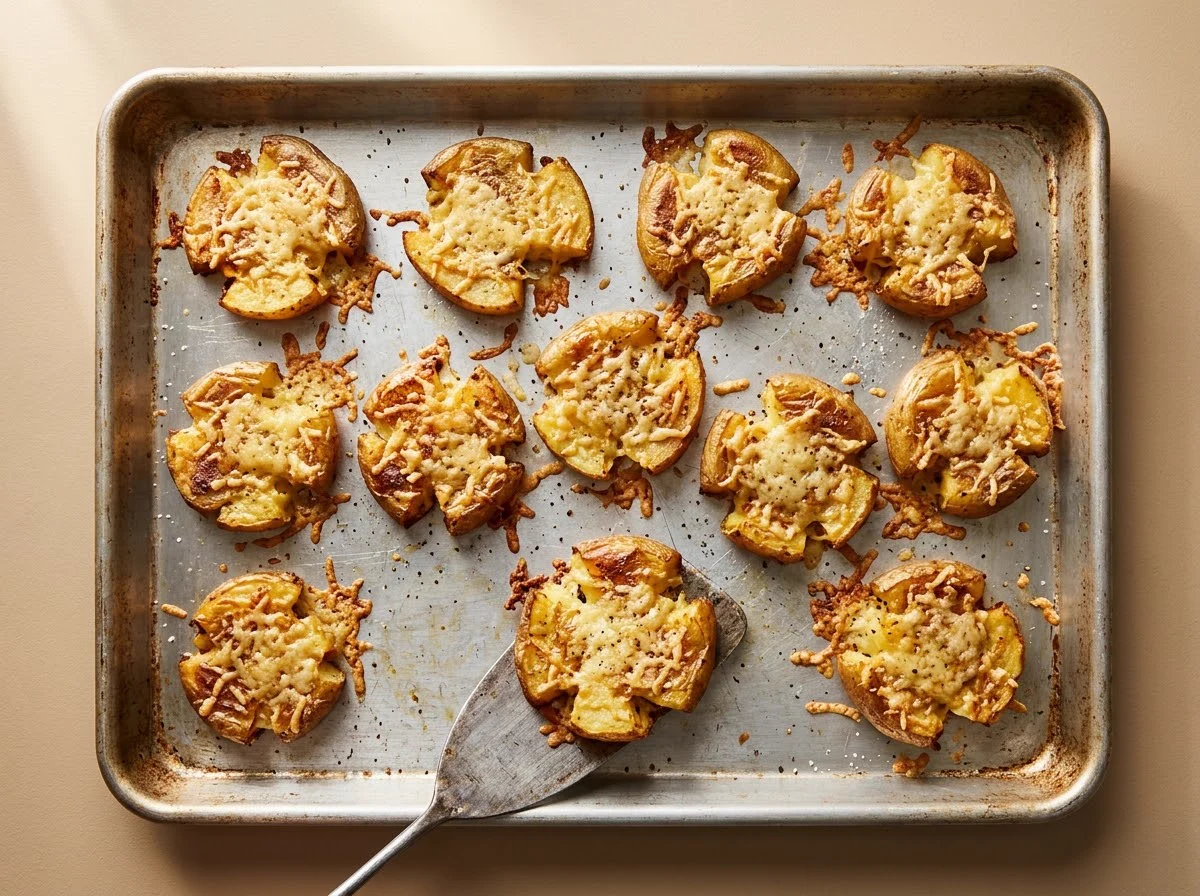
Roast for 25–30 minutes. The cheese and the thin edges should turn deep gold. Slide a thin spatula under one of the middle potatoes to check its base. Give the tray a few more minutes if the base is pale, keeping an eye on any loose pieces that already look dark.
Step 8. Rest briefly, then lift and serve
Let the potatoes stand on the tray for two minutes so the melted cheese can firm up. Slide the spatula under each potato and its cheese rim together. Scatter on the chopped parsley once they’re on the plate and serve while the edges are still crisp.
What to do when some potatoes break
Press slowly and straight down. If the glass sticks, release it with a slight twist and bring the pieces back together with a thin spatula. Keep loose fragments close to a larger piece or move any very small ones to the edge of the tray so you can pull them out early. Fine shards of potato and Parmesan brown sooner than the centers.
How to reheat for crisp edges
Refrigerate leftovers within 2 hours. Reheat on a lightly oiled sheet pan until crisp and 165°F (74°C) in the center. Leave a little space between the potato pieces so steam can escape. Add a fresh sprinkle of parsley after reheating.
If the tops brown before the bases
Check a potato near the middle of the tray and one near the edge. If the middle is pale underneath, move the tray down a rack for the final few minutes and watch the tops closely. A heavy metal tray that sits flat usually browns more evenly than a thin tray that bends in the oven.
Choose another potato if you need to
Baby red potatoes can take the place of Yukon Golds. Their skins tend to hold together well, and the centers are a little waxier. When using a mixed bag, pull the smallest potatoes out of the water first as soon as a knife goes through. Let the larger potatoes finish while the small ones steam-dry.
Frequently asked questions
Why do I boil the potatoes first?
Boiling makes the centers tender enough to flatten while roasting crisps the exposed edges.
Why are my potatoes not crisp?
Surface moisture and crowding can prevent browning. Steam dry after draining and leave space around each potato on the tray.
When should I lift them from the tray?
Leave them for 2 minutes after roasting, then use a thin spatula to lift the cheese-crusted edges.
Can I boil the potatoes ahead?
Yes. Drain, cool and refrigerate them promptly in a covered container. Pat them dry before pressing and let a cold potato sit for a few minutes if the skin splits sharply when you press it. Add a little oven time if the centers are still warming when the edges turn gold.
Estimated nutrition
Per serving, approximately 230 kcal, 6.8 g protein, 31 g carbohydrates and 9.1 g fat. Includes all the olive oil and Parmesan.
Serve alongside a roast or with a thick yogurt dip. For a potato side you can make with larger potatoes, try Crispy Oven Potato Wedges.
Reader comments